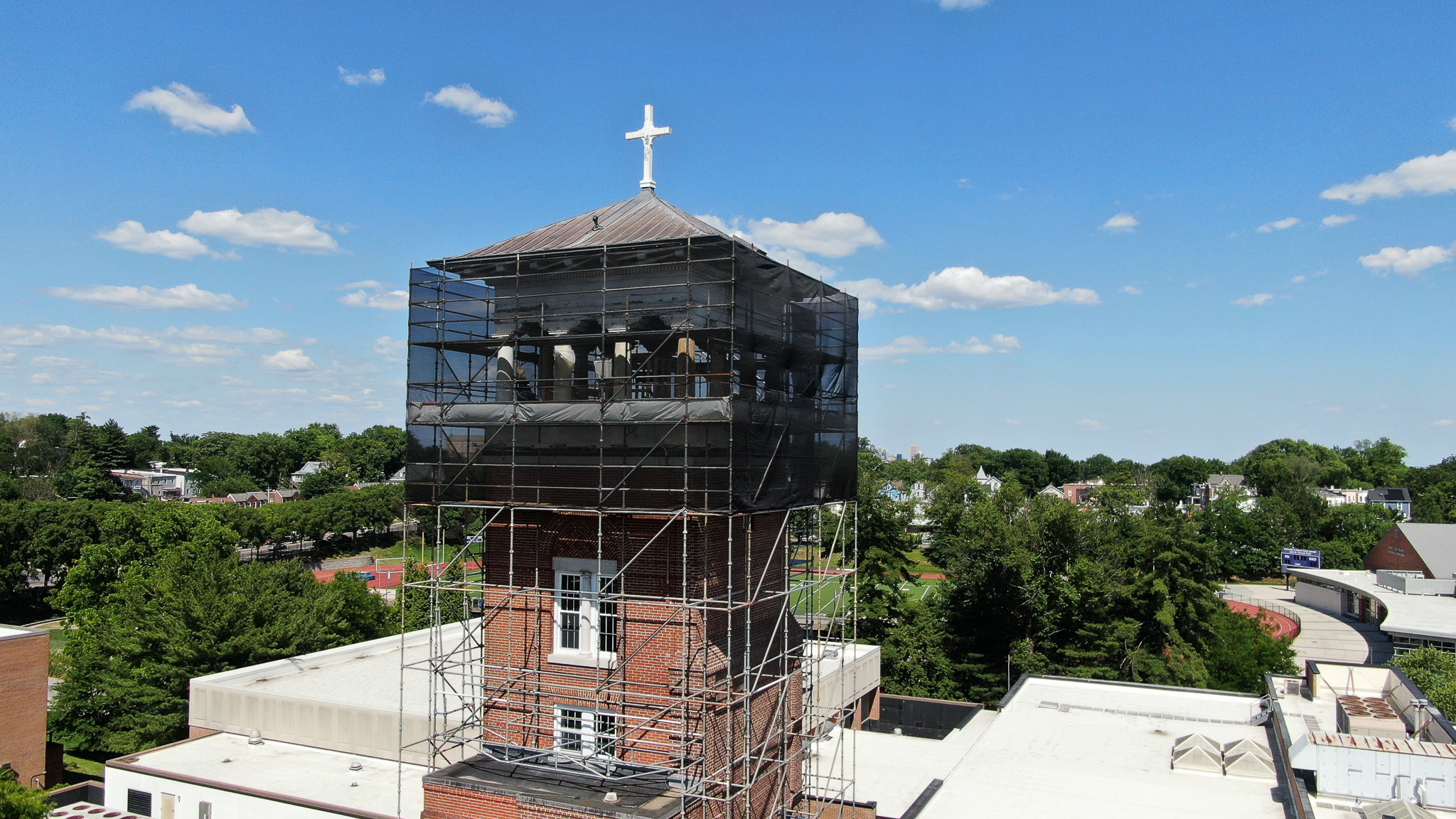
From the Spring 2022 issue of The Mount magazine
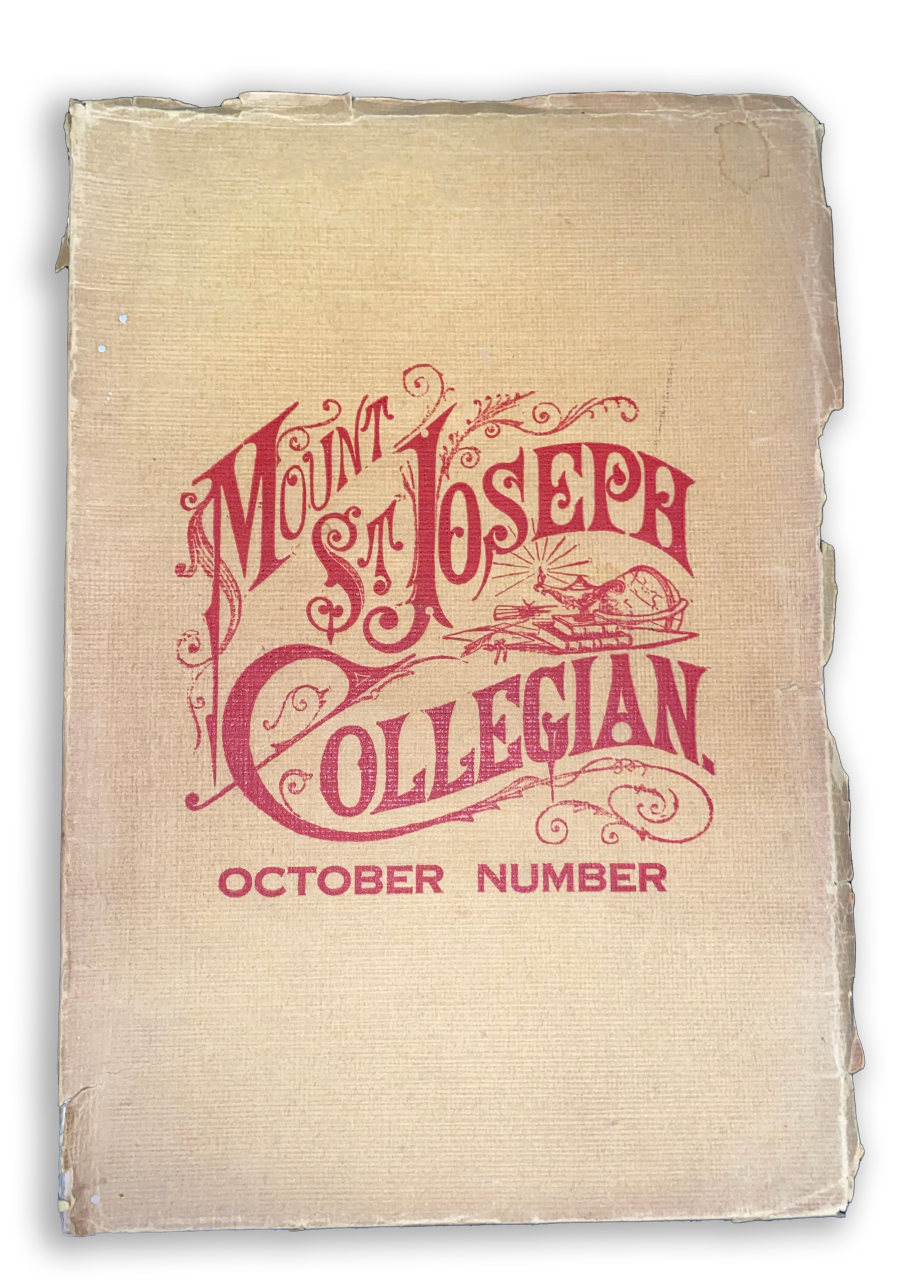
Mount Saint Joseph Develops First Student Publication
“The Collegian is published by the students of Mt. St. Joseph’s College. Its purpose is to aid literary improvement and to record news of the College. As the paper is, for the most part, devoted to matters which may not prove interesting to the general reader, it must look for its support chiefly to the students, the graduates, and their friends. These, we trust, will need no further incitement to extend to us their patronage.”
This excerpt introduces each issue of the Collegian, Mount Saint Joseph’s first student publication. The cost to the reader was $1 per year or $0.10 per monthly issue. In 1916, the publication schedule changed from monthly to quarterly and costs were adjusted to $0.25 per quarterly issue. While more of a booklet than a newspaper, the content included newsy features, opinion pieces, and other journalistic material. However, it also served as a yearbook and literary arts magazine, incorporating student portraits, short fiction, and poetry.
The Quill Wins New Praise
Headline from Oct. 2, 1942, issue of The Quill
In 1930, the Collegian was renamed The Quill, while still serving as a yearbook/quarterly newspaper hybrid. In 1942, The Tower was created as a standalone yearbook and The Quill transitioned to a traditional student newspaper. Flipping through the archives, a reader would find familiar stories of students learning to drive, new faculty being welcomed to the school community, seniors preparing for prom, clubs organizing charity food drives, and, of course, the latest in athletic achievement for the Gaels; the “harriers,” “hoopsters,” “binglers,” “gridders,” and “purple pig-skinners” are celebrated in the sports section headlines.
Since its establishment, The Quill has always been a high-rating publication. According to the October 2, 1942, issue of The Quill, the paper earned 915 of a possible 1000 points in its rating by the Northwestern University Society, receiving the highest possible scores for general make-up, original innovations, advertising, and circulation.
Judges said of the publication, “Very seldom does a newspaper of high school grade present such a newsy appearance, with its resultant reader interest, as The Quill achieves by its effective use of so many excellent cuts. The photographic nameplates for the pages are unique and satisfying examples. All this is backed up by skillful writing and careful training in the other fundamentals of good journalism.”
Trading a Quill for a Keyboard: Newspaper Goes Digital
When Mount Saint Joseph started the 1:1 iPad Program in 2016, Ed Schultheis ’99, faculty moderator for The Quill, saw an opportunity to create an online version of the paper. “There was a lot of support for going digital, with getting rid of the costs for printing and the immediacy of it, but there was also some trepidation. There is something really enjoyable and nostalgic about picking up a newspaper and reading it, but then, what do you do with it afterwards? Usually, it ends up in the recycling bin.”
The digital model allows students to publish timely content when their schedules allow. When the paper was printed, Ed struggled to find students who were willing to write consistently since it could take upwards of a month to see their published work. Currently, contributors to The Quill include students in Ed’s multimedia journalism class, as well as some “freelancers,” who are a part of Ed’s specialized homeroom.
“The schedule of a student ebbs and flows around the quarter,” Ed explains. “Sometimes I have a plethora of material that’s coming in, and sometimes I have a desert of material. That’s part of the reason I love being online, because when I have content, I can get it published. As opposed to holding on to it, waiting for 16 stories before I could print it in a paper.”
Moving online has also opened up opportunities for students to contribute a wider variety of media, such as a podcast, video animations, and a new Instagram account called InstaGael News, which regularly posts interview-style news clips from events around campus.
No matter the platform, Ed says he is just happy to see students excited about creating and publishing content. “I found that joy during my journalism classes as a student here,” he says. “I loved picking up the newspaper and reading my stories and analyzing them, seeing where I could have improved. I feel that I get to spread that joy and have students experience it too. Because of the data that’s behind the website, those guys are able to get on every day and look at how many views their articles have and how many likes they’re getting on Instagram. They’re publishing material and people are viewing it, and that is a hook for journalism right there.”
Check out the latest Quill content at https://msjstudent.media/.
From the Archives
St. Joe Educates the Whole Man
Originally published Oct. 20, 1967
By Tom Yingling ’68
What makes a school outstanding? We must realize that education consists of more than merely developing a person intellectually. Scholastically speaking, St. Joe is known to be excellent, but when I say that St. Joe is an above average school, I am referring to its potential to develop boys into well-rounded men.
Pursuit of Maturity
For those who would tend to disagree with me, please note that I spoke of the school’s “potential.” Simply attending class for four years gives one nothing more than a basic college preparatory course. An education in maturity can only be acquired by the individual when he himself is ready to pursue it. Analyzing St. Joe’s “potential,” it’s easy to see that the outside activities offered are specifically geared to develop the many aspects of a student’s personality and character.
Development of Potential
St. Joe can give a student much more than four years of facts and figures if he remains awake to the opportunities around him. At a time of life when we begin to question the value of everything, we at St. Joe are in good position to find our own answers. The outlets we have now for meeting new people and sampling the many aspects of life can become fulfilling in later years. It’s important to realize this now, to realize the potential in our school and, in particularly, in ourselves.
Quill Strikes Out Against Those Who Disparage It
Originally published Mar. 12, 1954
By Joe Green ’54
At the end of each marking period, a school publication known as The Quill reaches the student body. Not one in twenty students reads the entire paper, though. However, one hears the gripes and criticisms of the malcontents who are never satisfied. Why do they defame our paper? Mainly because they think we throw it together in about a week. Some misguided souls even think we print the paper in the Quillroom.
Actually we start work on the very first day of the marking period by making out diagrams of each page. Here we figure how long each article should be, what type headline to use, where to place each article, and how many pictures to use. Then the assignments are given to each reporter. For about two weeks we work on our articles and then the final drafts are typed and sent to the printer. He sends back the galley sheets, long printed sheets with a few articles on each. These follow no definite pattern but are used solely for finding and correcting grammatical errors made by either the printer or us at The Quill. The printer also sends back a copy of each page on which the editors cut up and fit the articles into the corresponding spaces on the make-up sheet. This sometimes means a bit of cutting as there is usually a trouble spot.
After everything meets the approval of the advisor and the page editors, it is sent back to the printer for the final copies. Approximately three days later The Quill returns to M208. It is then distributed to the student body, which immediately begins its monthly tirades against our work. So this month when The Quill appears, try to bear with us and our humble offering. After all, it’s only the best in the state as attested by the Maryland Scholastic Press Association.
Mount Tuition Increased by Twelve Percent
Originally published 1980
By David Frick ’80
For the 1980-81 school year there has been an increase in tuition from $1050 a year to $1180 a year. This is an increase of 12% or $130. The reason for this increase can be attributed to several things. Among these are inflation and the rising salaries of teachers. Though the tuition may seem high it would seem that on the whole the parents and faculty feel it is worth it. The increase in tuition can be counted on to help repair and replace things in the school and pay for increasing fixed costs such as heating oil.
The New JUG
Originally published Dec. 1, 1955
Although the JUG set-up this year is a little different than last, the purpose remains the same. This year anyone who gets JUG must go to the office after school. When he gets there he receives a paper which he must be able to write from memory after studying it for forty-five minutes. If he fails to do this he must come back the next day and do it over again.
Every time a person goes to JUG he receives a different article. The subject matter of the first three or four articles, which were compiled by Mount Brothers, is on “How to Study.” The rest are poems, stories, etc. Furthermore, this year, a person can be suspended from school if he has been to JUG too many times.
Hear the Bass Go Boom!
Is there a need for loud systems?
Originally published April 1992
By Robert Eckert ’93
Have you ever been sitting in your living room, enjoying an icy beverage and notice that the glass you’re drinking from as well as your mother’s good china, have suddenly started to vibrate? In the olden days people would think that it was an earthquake, but in this day and age it’s probably the booming bass bouncing out of someone’s trunk.
Stereos have come a long way since Wolfman Jack on AM radio. Radios are now referred to as sound systems, sometimes containing several large scale speakers along with many high powered amplifiers.
What do you need all this sound for? I asked a couple of people this. “It’s the same as a flashy paint job or a loud engine. It’s an attention getter,” said Josh Verbetti, the owner of one of the largest car stereo systems in Brooklyn Park. Former Mount student Will Hauer had this to say with regard to the booming bass craze: “It’s just a fad. It’ll pass away with rap music.”
Rap music is the most popular kind of tune for these high intensity stereos, because of the high output of bass. Most of these kicker boxes take the bass in the music and amplify it to ground shaking proportions.
“I just wanna listen to music,” said Josh Forgione ’93. There are still some people who don’t feel the need to have all this power emanating from their mode of transportation. A lot of people only need the basics, such as Joe Vogel ’93, who said, “Hey, it’s got to have a cassette player and a radio, and I don’t need any of that bass stuff.” Maury LaPointe ’93 had this to say about the issue, “It’s just got to play. The one that comes with the car is fine.”
Sometimes these high powered stereo systems can run you well over a couple thousand dollars. Amps alone can run you anywhere from 20 to 6000 dollars. The boxes which contain the woofers and tweeters can set you back a couple hundred dollars.
In my own opinion, I’d much rather work on the sound of my engine, but that’s me.